News Release
No Salmon Farms, Yet Still Sea Lice
Another year has passed, marking ten years of sea lice monitoring in the Broughton Archipelago and nine years in the Discovery Islands, and the data continue to confirm that BC salmon farms are not driving sea lice levels in wild Pacific Salmon.
Liǧʷiłdaxʷ TERRITORY/CAMPBELL RIVER, BC — Recently, MOWI Canada West Published its 2026 Wild Juvenile Salmonid Monitoring Program Data. The report adds to the growing body of evidence that salmon farms are not driving sea lice levels in wild Pacific salmon challenging claims made by anti-salmon farming activists.
Salmon farms were removed from the Discovery Islands in 2022 and from the Broughton Archipelago in 2024, largely due to concerns raised by activists claiming that salmon farms were concentrating and releasing naturally occurring parasitic sea lice in regions that would, in turn, impact out-migrating wild salmon smolts.
These closures caused significant economic impacts, including 1,500 fewer jobs, $640 million in lost economic activity, the cancellation of more than $1 billion in investment, and 35,000 tonnes of farmed salmon removed from production.
While BC farmed salmon production decreased, Canada imported over $765 million worth of farmed Atlantic salmon from countries such as Norway and Chile in 2025, according to Statistics Canada.
Fisheries and Oceans Canada (DFO) regulates sea lice levels on farmed salmon during wild juvenile salmon out-migration. As part of the regulatory framework, independent registered professional biologists are contracted to monitor sea lice levels on wild salmon smolts in salmon farming regions. These data are published online in publicly available data reports.
In the Discovery Islands and Broughton Archipelago monitoring has continued after salmon farms were removed, providing an important baseline for the natural pressures of sea lice on wild juvenile pink and chum salmon.
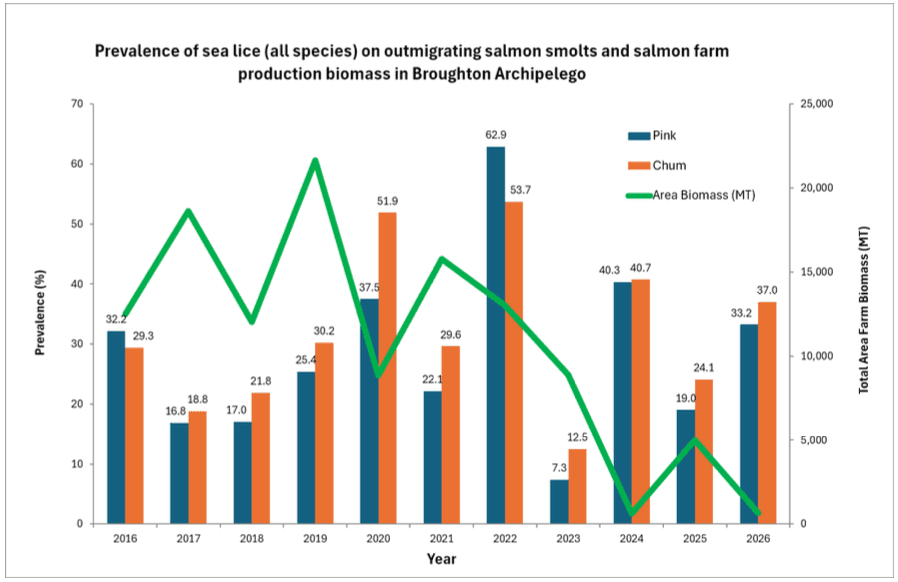
As evidenced in the attached graphs, the prevalence of sea lice (the percentage of juvenile salmon that are infected with sea lice) and the intensity of sea lice (the average number of sea lice on infected fish), do not decrease or disappear, as is repeatedly reported to the public by anti-salmon farming activists. Instead, a natural year-to-year variability is shown in the data.
Independent scientists are currently analyzing these data to further investigate relationships between specific farm salmon stocking levels, oceanographic conditions, and other factors that will further improve scientific understanding of sea lice biology in the Pacific Northwest. This research will be submitted for peer review.
“BC Salmon Farmers are committed to ensuring that salmon farms coexist with wild salmon in coastal British Columbia. Sea lice monitoring and innovation to ensure that sea lice levels on farmed salmon cannot spread to wild salmon are a critical part of operations,” said Brian Kingzett.
During a time of unprecedented economic instability and rising food costs, BC Salmon Farmers are ready to answer the call in support of the government’s National Food Security Strategy by producing more Canadian-made food for Canadian plates.”
BC Salmon Farmers are committed to science-based innovation, transparency and coexistence with wild salmon in their operations. Learn more about science related to salmon farming, including sea lice, in our Modern Science Review
FIGURES

Figure 1. Prevalence of sea lice (all species) on out-migrating wild juvenile pink and chum salmon, Broughton Archipelago, 2016 to 2026. Bars show the percentage of juvenile salmon infected. The line shows total salmon farm production biomass in the area, in metric tonnes, which fell sharply after 2023.

Figure 2. Prevalence of sea lice (all species) on out-migrating wild juvenile pink and chum salmon, Discovery Islands, 2017 to 2026. Bars show the percentage of juvenile salmon infected. The line shows salmon farm production biomass in metric tonnes, which has been zero since 2022.

Figure 3. Intensity of sea lice (all species) on out-migrating wild juvenile pink and chum salmon, Broughton Archipelago, 2016 to 2026. Bars show the average number of sea lice on infected fish. The line shows total salmon farm production biomass in the area, in metric tonnes, which fell sharply after 2023.

Figure 4. Intensity of sea lice (all species) on out-migrating wild juvenile pink and chum salmon, Discovery Islands, 2017 to 2026. Bars show the average number of sea lice on infected fish. The line shows salmon farm production biomass in metric tonnes, which has been zero since 2022.
ABOUT THE BC SALMON FARMERS ASSOCIATION
The BC Salmon Farmers Association represents nearly 60 businesses and organizations throughout the value chain of finfish aquaculture in BC. Our members account for over 95% of the annual provincial harvest of farm-raised salmon in British Columbia.
Farm-raised salmon generates over $1.17 billion for the provincial economy, supporting 4,560 well-paid full-time jobs. Additionally, farm-raised salmon provides a nutritious and sustainably produced protein with a low carbon footprint that contributes to Canada’s food security and Blue Economy.
BC salmon farmers are committed to reconciliation. All farms operating in BC are currently in agreement, negotiation, or established partnerships with First Nations in whose territories we operate. These agreements are founded upon recognizing First Nations’ right to exercise jurisdiction over the land, resources, and waters within their territories.
For more information, visit bcsalmonfarmers.ca
MEDIA CONTACT
Andrew Nixon
andrew@bcsalmonfarmers.ca
250-895-1761