News Release
BCSFA funds three new marine research projects

BCSFA FURTHERS SUPPORT OF STRONG INDEPENDENT SCIENCE
FUNDING ANNOUNCED FOR PROJECTS THROUGH MARINE ENVIRONMENTAL RESEARCH PROGRAM
CAMPBELL RIVER, B.C. – The independent Science Advisory Council of the BC Salmon Farmers Association (BCSFA) has approved $170,000 in funding through the Marine Environmental Research Program for three projects it views as crucial to the collective understanding and sustainability of the marine ecosystem on B.C.’s coast.
The Marine Environmental Research Program has now developed collaborations, helping to bridge knowledge gaps on B.C.’s wild stocks and coastal environment, on nine research projects providing almost $600,000 in funding. Six of those projects will be ongoing in 2017/18, which will see BCSFA and its member companies collaborating with 15 organizations and 26 researchers on key projects such as developing a Pacific cleaner fish for sea lice management, revolutionary acoustic tagging of migrating salmon smolts, and further investigation into understanding important pathogens that may be affecting wild or farm-raised salmon.
In December 2014, BCSFA launched the Marine Environmental Research Program (MERP) and committed $1.5-million over five years (2015 – 2020) to fund research, through a competitive process, that will provide a better understanding of the marine environment and B.C.’s wild marine species, particularly wild salmon stocks.
The research-funding program, which is open to all research organizations, is managed by a third-party Science Advisory Council (SAC) comprised of members from the University of British Columbia, Vancouver Island University, B.C. Ministry of Agriculture, Fisheries and Oceans Canada, Pacific Salmon Foundation, as well as industry experts.
“The BCSFA Science Advisory Council has facilitated a number of important research collaborations that are starting to provide great insight into our local ocean environment, wild salmon, and furthering sustainable innovations in aquaculture,” said Jeremy Dunn, Executive Director, BC Salmon Farmers Association. “Salmon aquaculture has always been an industry that values quality science done in an objective and transparent manner.”
2017/18 funded projects:
Project: Spatial and temporal patterns of sea lice infestations on wild and farm-raised salmon on the British Columbia coast.
Collaborators: University of Prince Edward Island / Atlantic Veterinary College and University of St Andrews (Scotland)
Project team: Prof. Crawford Revie (UPEI / AVC), Dr. Thitiwan Patanasatienkul (UPEI / AVC), Prof. Christopher Todd (University of St Andrews)
Research Outline:
Researches at the University of Prince Edward Island have integrated data from several monitoring programs across the B.C. coast over a 16-year period (2001 – 2016) into a single dataset – the single largest dataset of its kind in the world. These data have been collected from over 300 locations covering around 12 regions along the B.C. coast, involving approximately one million fish captured; a quarter of which have been assessed for sea lice details. The analysis of these data should provide an integrated picture of sea lice infestation patterns on wild salmon populations in B.C., and allow for a more complete investigation of the factors contributing to spatial and temporal variations in infestations.
Investigation of these patterns in more detail will improve our knowledge of sea lice population dynamics on wild salmon. This may also provide for a better understanding of sea lice exchanges between farmed and wild salmon populations, in both directions.
***
Project: Isolation of Aeromonas salmonicida and Piscirikettsia salmonis from farmed and wild salmonids in B.C. to support diagnostic test evaluation and epidemiological studies.
Collaborators: BC Centre for Aquatic Health Sciences (BC CAHS), Fisheries and Oceans Canada, Elanco,
Project team: Dr. Ahmed Siah (BC CAHS), Dr. Stewart C. Johnson (DFO), Zina Richmond (BC CAHS)
Research Outline:
With the further advancement in technology and understanding of the genomics of Atlantic salmon and pathogens that affect them, scientists are able to develop diagnostic tools at a finer scale than ever before. This is an important project to understand the genomics of pathogens endemic to British Columbia that are having an affect on farm raised salmon. The genomic data for these pathogens will inform the development of vaccine and treatment methods, as well as enable the identification of previously unrecognized genomic features such as plasmids in B.C. isolates.
The research team will develop specific diagnostic assays to detect the pathogens in samples of fish and later environment. In this way, mitigation strategies that include reducing therapeutant use, siting, migratory passage timing and pathogen flow can be developed.
For example, with exception of two B.C. isolates that were compared to Chilean isolates by Otterlei et al. (2016), there is very little known about the phenotypic and genetic makeup of Psal in B.C. waters or in native fishes. The Psal phenotypic and phylogenetic analysis identified two major Chilean clades from which the Canadian isolates are genetically different (Otterlei et al., 2016).
***
Project: Investigations into implementing the use of kelp perch and pile perch as sea lice cleaner fish for farmed Atlantic*
Collaborators: BC Centre for Aquatic Health Sciences (BC CAHS), Vancouver Aquarium Marine Science Centre (VAMSC), Cermaq Canada, Grieg Seafood BC, Marine Harvest Canada, Sea Pact
Project team: Dr. Shannon Balfry (BC CAHS), Sam Ferguson (BC CAHS / DFO), Dr. Simon Jones (DFO), Dr. Diane Morrison (Marine Harvest Canada)
BCSFA Steering Committee: Linda Hiemstra (BCSFA), Dr. Diane Morrison (Marine Harvest Canada), Dr. Barry Milligan (Cermaq Canada), Dougie Hunter (Marine Harvest Canada), Frode Mathisen (Grieg Seafood)
Research Outline:
Salmon farmers around the world are working to develop non-chemical based treatments for managing sea lice. The copepods – which are found naturally in the ocean – parasitize both farmed and wild fish populations. New research started at the Vancouver Aquarium Marine Science Centre suggests that local B.C. perch species are effective in picking sea lice from salmon. The use of one kind of fish to “clean” another is a proven method of managing sea lice in salmon culture in Norway and Scotland, however this research is the first on fish native to B.C. waters.
Several preliminary trials — conducted at the Fisheries and Oceans Canada (DFO) Centre for Aquaculture and Environmental Research — determined that both kelp perch and pile perch will clean sea lice off experimentally infested salmon. Researchers looked at differences in cleaning activity between the two species of perch and in different sizes of the perch, and at cleaning preferences in terms of sea lice life history, location of sea lice on salmon, and behavior of cleaning in the lab.
*This research was initially funded by the Marine Environmental Research Program in 2016 and has received additional funding to continue in 2017.
***
Ongoing funded projects
Project: Understanding Pacific Salmon Migration – Sockeye, Coho, Chinook
Collaborators: Pacific Salmon Foundation, University of British Columbia, Kintama Research Services, Canada’s Ocean Tracking Network, Fisheries and Oceans Canada
Project team: Dr, Brian Riddell (Pacific Salmon Foundation), Dr. Isobel Persall (Pacific Salmon Foundation), Dr. David Welch (Kintama), Dr. Erin Rechisky (Kintama), Dr. Paul Winchell (Kintama), Dr. Scott Hinch (UBC), Dr. Tony Farrell (UBC), Dr. Kristi Miller (DFO).
Research Outline:
This research is based on cutting-edge acoustic tagging technology, involving implanting wild juvenile salmon (with a focus on sockeye) with acoustic transmitter tags, and deploying arrays of receivers that pick up signals from tagged fish as they swim by. This technology allows researchers to track individual juveniles along their migration from freshwater out to the open ocean, and gain insight into their behaviours along the way. The study will focus on observing the out-migration of juvenile sockeye salmon from Chilko Lake through the Strait of Georgia, Discovery Islands, and Johnstone Strait. For the first time, researchers will use tags small enough to implant into 1-year-old sockeye smolts. Tagging such small fish will allow for a better assessment of migration behaviours of the entire population. The work is part of the wider Salish Sea Marine Survival Project (marinesurivalproject.com).
***
Project: Structure and Function of the Salmon Farm “Reef”
Collaborators: North Island College Centre for Applied Research, Technology and Innovation (CARTI), University of Victoria, Fisheries and Oceans Canada Demersal and Benthic Services Branch
Project team: Dr. Stephen Cross (NIC - CARTI), Dr. Chris Mckindsey (DFO), Ms. Kylee Pawluk (NIC – CARTI)
Research Outline
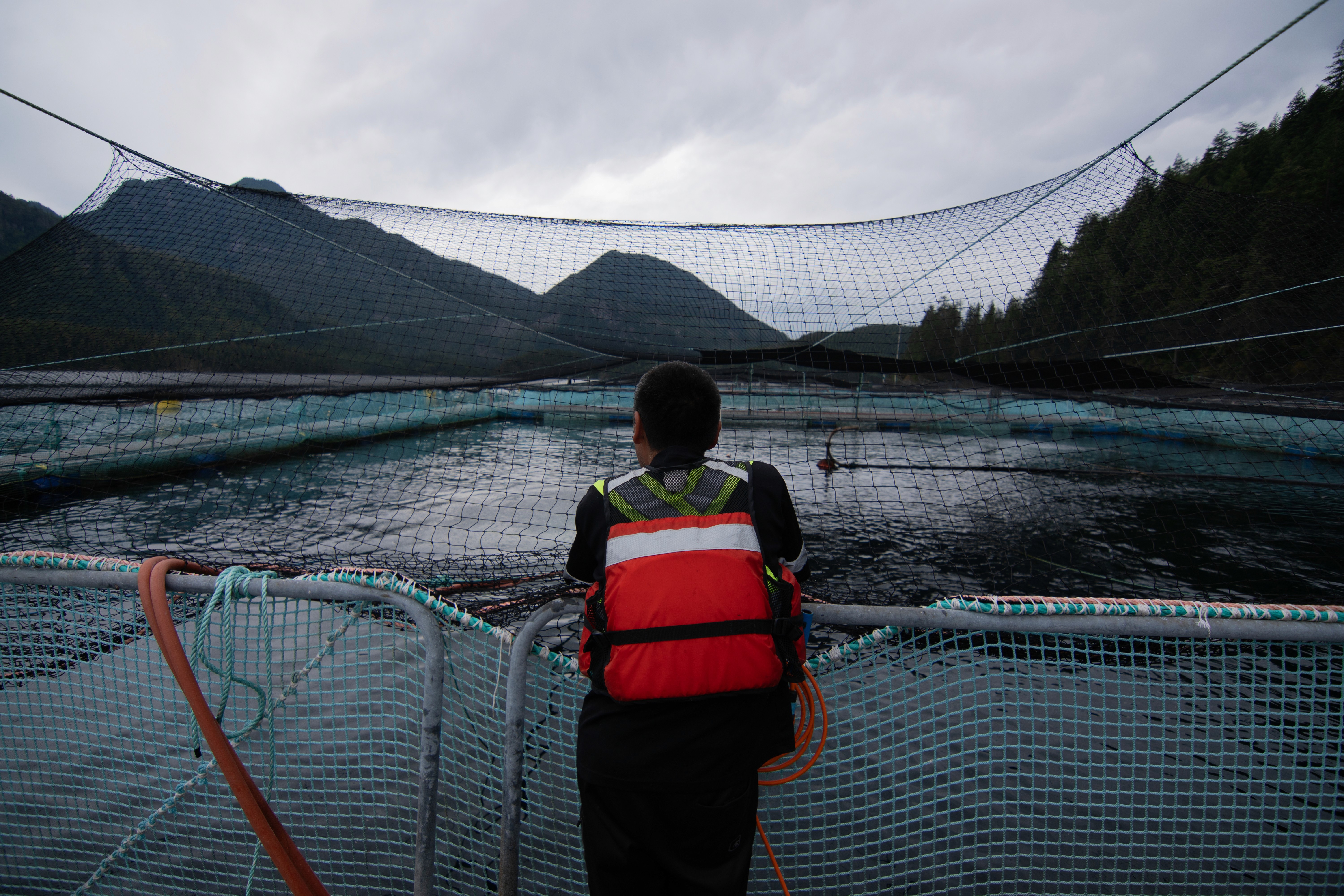
Fish farms create unique habitats for marine sea life. This project seeks to explore how the aquatic environment around salmon farms is used as a new habitat for marine plant and animal life, at different stages of the farm’s production cycle. The research team will document the composition and relative productivity of the salmon farm reef across a variety of farm site locations in B.C. providing a detailed review of the reef, including a summary of how the farm interacts with the natural environment. On each farm, researchers will document the change in reef community structure (plants and animals) over time, identifying species composition, relative abundance, and quantifying the differences in productivity associated with changing infrastructure and environments.
***
Project: Marine reservoirs of infectious agents associated with proliferative gill disorders in farmed salmon
Collaborators: BC Centre for Aquatic Health Sciences, BC Animal Health Centre, Fisheries and Oceans Canada, Marine Harvest Canada
Project team: Dr. Simon Jones (DFO), Dr. Gary Marty (BC Animal Health Centre), Dr. Sonja Saksida, Dr. Diane Morrison (Marine Harvest), Ms Sharon DeDominicis (Marine Harvest), Dr. Marc Trudel (DFO).
Research Outline
This research will see the examination of wild fish collected through sea lice monitoring programs as well as samples collected by DFO further offshore for their involvement as reservoirs of infection associated with proliferative gill disorders being noted in cultured salmon. This knowledge will inform further development of farmed fish health management strategies and produce information on the prevalence of gill disorders in wild fish. The research team will seek to determine the distribution of proliferative gill disorders sources in wild Pacific salmon and salmon lice at various locations relative to marine net pens, describe the occurrence of proliferative gill disorders in wild fish, and determine the genomic sequence of B.C. variants of proliferative gill disorders sources. Laboratory transmission studies will be conducted to identify and quantify (host and environmental) parameters surrounding transmission of causative agent between candidate reservoir species and Atlantic salmon.
For a full list of projects, visit the BCSFA website at http://bcsalmonfarmers.ca/research-innovation/
About the BC Salmon Farmers Association:
B.C. salmon farmers grow 58% of all salmon raised in Canada and account for 60% of the total landed value of seafood in British Columbia, generating more than $1.14-billion towards the provincial economy. The BCSFA represents the province’s vibrant and diversified salmon aquaculture sector, inclusive of companies raising salmon, as well as the businesses that proudly provide services and supplies.
For more information visit BCSalmonFarmers.ca
Media Contacts:
Sabrina Santoro
Sabrina@bcsalmonfarmers.ca
604.202.4417